



Oman or Sultanate of Oman borders the United Arab Emirates, Saudi Arabia and Yemen, it also includes Madha, an exclave enclosed by the United Arab Emirates, and Musandam, an exclave separated by Emirati territory. It gained independence in 1650 with the expulsion of the Portuguese.
The capital city is Muscat. Oman's attractions include a largely-untouched coastline, mountains, deserts and the burgeoning capital Muscat, with its forts, palaces and old walled city. Some of its renowned attractions include Bahla Fort, The Frankincense Trail, the Old Muttrah Souk and Sultan Qaboos Grand Mosque.
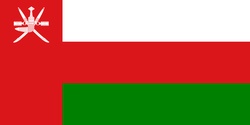
Omani’s flag has three horizontal bands equal in width of white, red, and green with a broad, vertical, red band on the left hand side.
The national emblem (a khanjar dagger in its sheath superimposed on two crossed swords in scabbards) in white is centered near the top of the vertical band.
Oman
About Oman
National Olympic Committee

Climate
Oman's climate is hot and dry in the interior for the most of the year with the exception of Dhofar region where there is a cool wind from the Indian Ocean and humid along the coast.
During past millennia Oman was covered by ocean.
Today fossilized shells exist in great numbers in areas of the desert.
The average summer temperature in Muscat is 33° C, but a strong wind that blows from the Rub al Khali, can raise temperatures from the towns on the Gulf of Oman by 6° C to 10° C.
Winter temperatures are mild and pleasant, ranging between 15° C and 23°C.
Sports
The Football is one of the most popular sports along with the Handball, Basketball, Hockey, Volleyball, Athletics, Swimming, and Tennis Associations. Due to the geographical nature of Oman and long coastline, the beach sport is very popular among Omani people and beach sports are played on a daily basis.
Oman successfully hosted the 2nd Asian Games in the city of Muscat.
Culture
Oman’s culture is deeply rooted in the Sultanate’s proud heritage and history of seafaring, trading and exploration. Today, long-standing traditions blend seamlessly with modern day living, with the latest fashion and electronics brands sold alongside traditional hand-made crafts, jewellery, and even goats and cattle at souqs around the country.
Oman takes great pride in its magnificent ecology and diverse flora and fauna, actively protecting it through the establishment of nature reserves such as the Daymaniyat Islands near Muscat, the turtle reserve at Ras Al Jinz, the Land of Frankincense in Dhofar or the Arabian Oryx Sanctuary in Al Wusta.
Oman is a country of contrasts, from the fjords and rugged mountains in the north to the sandy deserts heading south and therefore it is one of the most attractive tourist destinations.