

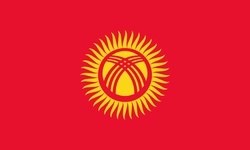
Kyrgyzstan which was historically known as the land of 40 tribes, is landlocked by Kazakhstan, Uzbekistan, Tajikistan and China.
It gained independence on 31 August 1991 from the Soviet Union. The capital city is Bishkek.
Sites of interest in Kyrgyzstan include Burana Tower, Ala Archa National Park, Son-Kul Lake, the remote mountain lake at an altitude of about 3000 meters, Tash Rabat a stone fortress and Suyab the ancient Silk Road city.
Kyrgyzstan
About Kyrgyzstan
Short Name
KGZ
Capital
Bishkek
Language
Kyrgyz, Russianv
Population
5,356,869
Area
199,900 km²
Calling Code
+996
National Olympic Committee
NATIONAL OLYMPIC COMMITTEE
National Olympic Committee of the Kyrgyz Republic
NOC President
Secretary General
Recognition Year
1993
Address
40, Togolok-Moldo street, Bishkek,720001
Contact Details
Web Address
E-mail
Culture
Kyrgyz culture has been greatly influenced by their nomadic heritage. It is reflected in the way a household was run, in customs and rites.
People decorated their homes with items that were both beautiful and practical. The masterpiece of folk creation is the Kyrgyz yurta and is very important in their way of life.
They have always been living with cattle, especially sheep and horses from the very beginning were important animals, but also cows and goats are being raised, as well as donkeys for the smallest of the family to ride them.
Girls, learn the traditional handicraft creating very beautiful carpets that are made with months- or year-lasting work. Horse-back riding is one of the most important parts of Kyrgyz culture.
Climate
The climate in Kyrgyzstan varies regionally. The south-west is subtropical and extremely hot in summer, with temperatures reaching 40°C - 104°F.
The north varies from dry continental to polar climate, depending on elevation. In the coldest areas temperatures are sub-zero for around 40 days in winter, and even some desert areas experience constant snowfall in this period.
This kind of weather is attributed to its terrain including large lakes and mountains. In the valley areas of Kyrgyzstan a total amount of precipitation makes up 230-500 mm. In the mountainous areas it can reach 1500 mm.
In warm seasons precipitation falls more than in a cold ones and thunder storms are a frequent phenomenon.
Sports
The mountains are a perfect destination to enjoy adventure sports like climbing and skiing.
The Kyrgyz play many horseback games due to the importance of the horse in own culture, these include Ulak Tartysh, a team game resembling a cross between polo and rugby in which two teams of riders wrestle for possession of the headless carcass of a goat, which they attempt to deliver across the opposition's goal line, or into the opposition's goal: a big tub or a circle marked on the ground, Aht Chabysh - a long-distance horse race, Jumby Atmai - a large bar of precious metal (the "jumby") is tied to a pole by a thread and contestants attempt to break the thread by shooting at it, while at a gallop and Oodarysh - two contestants wrestle on horseback, each attempting to be the first to throw the other from his horse.
Recently, Kyrgyzstan has fallen in love with football. Since its independence from the Soviet Union, Kyrgyzstan established the Football Federation that governs everything related to football including the Kyrgyzstan national football team and it is a member of the Asian Football Confederation through the Central Asian Football Federation.
Another sport that Kyrgyzstan loves is wrestling. Kyrgyzstan took the silver and bronze medals in the 2008 Summer Olympic Games by Kanatbek Begaliev and Ruslan Tiumenbaev respectively for Greco-Roman wrestling. From a culture of strong physical competition, it is just fitting that they love watching one on one physical competition too.
Ice hockey is also quite popular in Kyrgyzstan and national team took first major win in an international competition in the 2011 Asian Winter Games Premier Division when they took the perfect 6-game 6-win streak.